Today we passed out updated progress reports. The report can be alittle confusing.
The top portion is what is used to calculate your grade. It looks like you have taken about 16 quizzes but, each entry is actually one problem on a quiz. Quiz2.3 is really question #3 from Quiz 2. We entered the information this way so that we could generate the bottom portion.
The bottom portion is not used for calculating the grade, but to provide feedback to you. It lists all of the goals that we have studied so far. You can see which topics you could improve in. Those are topics that you may choose to review and re-assess. The calculations are not averages, but they are calculated using a power formula.
Any other questions about the progress report?
Wednesday, October 22, 2008
Progress Reports.

Quiz 5 Content
Can you....
*find the derivative of a function at specific points?
*graph a derivative of a function given certain conditions about the function?
*develop and use a formula for calculating interest?
*apply the principles of logarithms?
Questions, comments, or issues -- leave a comment.
Tuesday, October 21, 2008
The Graph of the Derivative
We have spent the last couple of days looking at the graph of the derivative.
Here is a cool applet.
This video also talks about some of the things we have covered in class.
On a side note...what would you do if this was your prom?
Monday, October 20, 2008
Quiz 4 Comments...
Any comments, questions, or concerns about Quiz 4?
If you feel that Quiz 4 didn't truely show your knowledge on the learning goals, please come see me or Ms. Jones before or after school. We can give you additional opportunities to provide evidence that you understand the goals.
Saturday, October 18, 2008
 The Math Department needs volunteers to star in an International Video! Imagine being seen by millions, billions, ALOT of people.
What? Where? When? You will have to come to school on Friday, October 24th from 9:00 am to 11:00 am. We will provide you with breakfast and lunch. You will have your own "green room" to prepare for your video shoot. Unfortunately, we won't be able to accommodate performer riders, but we can meet some dietary requests.
Why? Mr. Bywater, Ms. Fulton, Mr. Remiasz and I participated in a workshop this summer to improve our teaching, which ultimately improves student learning. We designed a math lesson that we want feedback on. Math teachers from different schools will observe and critic the lesson. We will gain valuable information from having these experts analyze and evaluate our performance. This lesson will have a tremendous effect on our practices and will help establish the Jones College Prep Math Department as a well respected, research-leading department.
I want to thank those individuals that volunteer, in advance. Words cannot express our thanks, appreciation, and gratitude for your committement to helping the Jones College Prep Math Department grow and improve.
HW24
The answers to HW 24 were....
1.a.i. $10,500
1.a.ii. $2521.05
1.a.iii. $423.71
1.b. V(t) = 15000 ( 1 - .30 ) t = 15000 (.7) t , where t is the number of years after 1990.
2. Clarabell is wrong. The more expensive car will NEVER be worth less than the cheaper car. We verified this by looking at the graph of the two equations, looking at the table of the two equations, and by trying to find the intersection of the two equations.
Exponential Functions
Recently, we've been talking about exponential functions. We examined various exponential functions to determine which ones have the "proportionality property".
How did we determine if an equation had the proportionality property? What did we have to do?
We finally came to the conclusion that functions in the following form would have characteristics of the proportionality property:
f ( x ) = AB cx
where A, B and C are constants
Do you think there are limitations on the values of A, B, or C? Can they be decimals? Negative numbers? Equal to zero? Here is an applet that could help you answer these questions -- be patient, it takes a while to load.
Since we are examining exponential functions, here is a great tutorial and goes really well with "A Basis For Disguise", the classwork that we worked on Friday.
7 x= 5 ?
Can you write a general rule for writing 7 x as a power of 5?Here are some YouTube videos demonstrating how to solve exponential equations.
Thursday, October 9, 2008
POW10: Around King Arthur's Table

Questions or comments? Do you have an answer? What have you tried? What doesn't work?
HW20
We came up with the equation for the derivatives of two functions:
f(x) = 3x + 4
g(x) = x^2 - 9
For the f(x) function, we found that the derivative is always 3, no matter what value of x we used.
Some classes developed a conjecture for all linear equations...For ALL linear equations, the derivative IS the slope.
For the g(x) function, we found that the equation for the derivative is 2x, and changes depending on the value of x.
One class developed this conjecture for all quadratic equations...For ALL quadratic equations, the derivative = 2*A*x, where A is the coefficient of the x^2 term.
NOTE: These are conjectures, which we will accept to be true until someone can find an example where it doesn't work. Can you find an example that will prove our conjecture to be false?
Wednesday, October 8, 2008
Slippery Slopes

We then tried to examine the relationship between the y-value and the derivative. Some noticed some interesting patterns -- the y-values double and the derivatives double. What makes the y-values double? For #2, the equation is y = 10^x. What patterns for the y-values did you see or would you expect to see? What patterns for the derivatives did you see or would you expect to see?
Finally, our goal was to create an equation. For 1b, some said that the equation is:
Some others said:
Which is correct?
Can you create the equation for the derivative in terms of the y-value for problem #2?
Can you generalize the derivative of any exponential function (y = A^x)?
Thursday, October 2, 2008
Quiz 3
Do you have any questions, comments, or concerns about Quiz 3?
- Can you calculate the slope of a line?
- Can you find an equation of a line given two points that the line passes through?
- Can you find the slope of different secant lines of a curve/graph?
- Can you find the average rate of change given a scenario/table/graph/equation?
- Can you find the approximate instantaneous rate of change given a scenario/table/graph/equation?
- Can you find the derivative of an equation at a specific point on a curve?
- Can you draw a tangent line at a specific point on a curve?
Tuesday, September 30, 2008
Derivatives
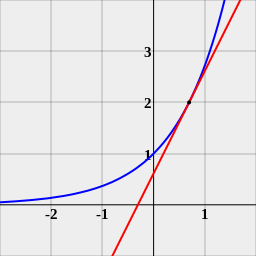
So we introduced the term derivative. A derivative is the exact value for the instantaneous rate of change at a specific point. To calculate the derivative, you would find the slope of the tangent line. A tangent line is a line that touches our graph at only one point and "does not cross the graph". This definition was one we came up with in class, and may need revising as we gain more knowledge of tangent lines.
We decided that our class will not actually calculate the derivative of the function using calculus techniques. Instead, we will continue to use our approximation technique. Some students have discovered an easier method of using the calculator to calculate the slope of the tangent line. Maybe they will share with us....
The answers to HW14 are:
1. -96
2. anything within 1% of 2866
3. -.14
Be prepared for a quiz...Can you approximate the instantaneous rate of change of a function at a specific point? For example, what is the derivative or instantaneous rate of change for f(x) = 3x^2 + 4 when x=5?
Monday, September 29, 2008
HW14
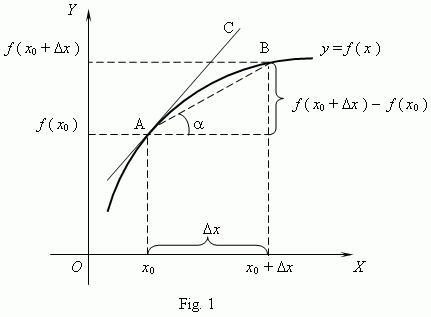
Questions, comments?
What is a Derivative? 
Visit our homework site for a file that explains instantaneous rate of change.
Confused...

I was a little confused today. We were discussing HW13, which for problem #2, asked us to find the average rate at which the oil slick grew. There seemed to be some confusion about how to do problem #2. Why? When this lesson was planned, Ms. Jones and I thought there would be very little confusion about #2. Were we mistaken to in thinking that?
To us, we thought of it as just another rate of change problem, which we have done alot of examples of -- even had several rate of change problems on our 2 quizzes. Why was this one different?
Sunday, September 28, 2008
That's Just The Way It Is
By now you have probably heard of some upcoming changes that will happen at Jones. How do you feel about the changes that have occurred at Jones this year? What are your feelings on the scheduled changes?
Watching this video (sorry if YouTube is blocked), there is a line..."We ain't ready, to see a black President"...any reactions?
But, How?
 How does this animation relate to what we are doing in class? And if you notice that at the end of the animation, there is a f'(Xo). What do you think f'(Xo) means?
Wednesday, September 24, 2008
What a minute...
Today in class we were looking at the graphs of average speeds, which we called "secant lines". We agreed that to calculate the average speed, we would take the change in distance and divide it be the change in time.  So we used this formula and found that our average speeds were
- 8 m/s from 0 secs to 50 secs
- 10.5 m/s from 25 secs to 50 secs
- 12 m/s from 40 secs to 50 secs
We noticed that as the average speeds increased, the slopes of the associated secant lines also increased (they got steeper).
Then we talked about finding the instantaneous speed at 50 secs. Students started mentioning strategies that sound very much like the strategy for finding average speed. They said we needed to use 2 points, and to use the average speed formula above.....
How is their strategy finding instantaneous speed? How is it any different than finding average speed? If their strategy is different, what makes it different?
We finished the class by using our calculators to zoom in on two points really close to the point, (50,400), in order to calculate the slope. Why should we care about the slope of these two points?
Tuesday, September 23, 2008
Average Speed VS. Instantaneous Speed
Can you compare and contrast "average speed" and "instantaneous speed"?
These sites might help...
http://mathworld.wolfram.com/SecantLine.html
http://en.wikipedia.org/wiki/Image:Derivative.png
http://www.ies.co.jp/math/java/calc/limsec/limsec.html
http://www.math.umn.edu/~garrett/qy/Secant.html
http://www.glenbrook.k12.il.us/GBSSCI/PHYS/mmedia/kinema/trip.html
http://library.thinkquest.org/C0110840/instant.htm
Questions, comments?
Monday, September 22, 2008
POW 9 solutions...
Today we went over different solutions to POW9.
The formula to calculate the height of the tallest platform:
ht = hi + d(n-1), where "ht" is the height of the tallest, "hi" is the height of the initial platform, "d" is the difference in height between the platforms, "n" is the total number of platforms.
Can you explain how this formula works?
One method to find the amount of fabric need for all of the platforms is to add up the height of each platform.
Fabric = hi + [hi + 1d] + [hi + 2d] + [hi + 3d] + ... + [hi + (n-1)d]
Notice that the last term, hi + (n-1)d, is actually hf, the height of the final platform.
But some people mentioned that adding up all of the heights is not an instant way to get amount of fabric. Plus, you kind of need to know the number of platforms to figure out how many times you have to add the numbers.
One formula that we could use to instantly calculate the amount of fabric need for all of the platforms:
Fabric = n(hi + hf)/2
Can you explain how this formula works?
See 3 very good examples of my POW journaling expectations. Example 1. Example 2. Example 3.
Friday, September 19, 2008
HW11
Today in class we were discussing HW11. Some classes didn't get an opportunity completely go over problem 5. Here are some student responses problem 5. Unfortunately, we have conflicting answers...so what do we do now?
Also, some students were not able to get to the BIG DOG problems from today's quiz. If you want to look at them here they are.