I found some last minute shopping deals...
Office Depot has their own brand graph paper (quad ruled) composition books for $.99. I highly recommend using these as your precalc notebooks. Five should cover the entire year for our class.
Also, Staples has a great deal on the TI-84 plus for $69.99 after rebates.
Enjoy the rest of your holiday weekend!
Sunday, August 31, 2008
Almost there...

Tuesday, August 19, 2008
WELCOME BACK!
I hope you enjoyed your summer. Did anyone do anything fun?
I spent my summer taking classes and reading. As a team, the math department participated in one week of IMP training and one week of Japanese Lesson Study. In addition, I attended a summer institute for National Board Certification. This school year, I will be working on my National Boards. If you have any video production experience, please let me know. Part of the requirements is to videotape our classes.
Mr. Remiasz and I have been working on the syllabus. We are planning on doing several IMP units and then finishing the year off with several Precalculus topics. There is now a Precaculus CLEP exam. Senior may want to think about taking the exam, which may give them college credit. Mr. Remiasz and I are also thinking about taking it.
I strongly encourage you to purchase several quad-ruled composition books from Staples. As of yesterday, they were still $1.00 each -- Thanks Mr. Lin. You will also need a TI graphing calculator. I recommend the TI-84 Plus Silver, which is also on sale at Staples for $99 after rebates. But any of the TI products will do.
I recommend reading some of the recent posts -- college readiness and grading philosophies. Also, watch this video and leave a comment.
Saturday, August 9, 2008
Are You College Ready?
Taken from "Toward a More Comprehensive Conception of College Readiness" from the Gates Foundation.
Recent research has shed light on several key elements of college success...often described as “key cognitive strategies”...emphatically identified...as important or more important than any specific content knowledge taught in high school...include analysis, interpretation, precision and accuracy, problem solving, and reasoning. Close behind in importance is knowledge of specific types of content knowledge. Writing may be by far the single academic skill most closely associated with college success, but the “big ideas” of each content area are also very important building blocks. Similarly important are the attitudes and behavioral attributes that students must demonstrate: study skills, time management, awareness of one’s performance, persistence, and the ability to utilize study groups.
College is different from high school in many important ways...College is the first place where we expect young people to be adults...Almost all of the rules of the game that students have so carefully learned and mastered over the preceding 13 years of schooling are either discarded or modified drastically...Transition from high school to college is one of the most difficult that many people experience during a lifetime. Because college is truly different from high school, college readiness is fundamentally different than high school competence. The college instructor...emphasizes a series of key thinking skills that students, for the most part, do not develop extensively in high school. The college instructor expect students to make inferences, interpret results, analyze conflicting explanations of phenomena, support arguments with evidence, solve complex problems that have no obvious answer, reach conclusions, offer explanations, conduct research, engage in the give-and-take of ideas, and generally think deeply about what they are being taught.
Several studies of college faculty members nationwide expressed near-universal agreement that most students arrive unprepared for the intellectual demands and expectations of postsecondary education...The primary areas in which first-year students needed further development were critical thinking and problem solving.
Successful academic preparation for college is grounded in two important dimensions—key cognitive strategies and content knowledge...Two academic skill areas that have repeatedly been identified as being centrally important to college success: writing and research. Writing is the means by which students are evaluated at least to some degree in nearly every postsecondary course. Students need to know how to pre-write, how to edit, and how to re-write a piece before it is submitted and, often, after it has been submitted once and feedback has been provided. College writing requires students to present arguments clearly, substantiate each point, and utilize the basics of a style manual when constructing a paper. College courses increasingly require students to be able to identify and utilize appropriate strategies and methodologies to explore and answer problems and to conduct research on a range of questions. To do so, students must be able to evaluate the appropriateness of a variety of source material and then synthesize and incorporate the material into a paper or report.
Math: Most important for success in college math is a thorough understanding of the basic concepts, principles, and techniques of algebra. This is different than simply having been exposed to these ideas. Much of the subsequent mathematics they will encounter draw upon or utilize these principles. In addition, having learned these elements of mathematical thinking at a deep level, they understand what it means to understand mathematical concepts deeply and are more likely to do so in subsequent areas of mathematical study. College-ready students possess more than a formulaic understanding of mathematics. They have the ability to apply conceptual understandings in order to extract a problem from a context, use mathematics to solve the problem, and then interpret the solution back into the context. They know when and how to estimate to determine the reasonableness of answers and can use a calculator appropriately as a tool, not a crutch.
Science: College science courses emphasize scientific thinking in all their facets. In addition to utilizing all the steps in the scientific method, students learn what it means to think like a scientist. This includes the communication conventions followed by scientists, the way that empirical evidence is used to draw conclusions, and how such conclusions are then subject to challenge and interpretation. Students come to appreciate that scientific knowledge is both constant and changing at any given moment, and that the evolution of scientific knowledge does not mean that previous knowledge was necessarily “wrong.” Students grasp that scientists think in terms of models and systems as ways to comprehend complex phenomena. This helps them make sense out of the flow of ideas and concepts they encounter in entry-level college courses and the overall structure of the scientific discipline they are studying.
In addition to the key cognitive strategies and content knowledge, a range of behaviors that reflect greater student self-awareness, self-monitoring, and self-control of a series of processes and behaviors is necessary for academic success. The key academic behaviors consist largely of self-monitoring skills and study skills. Self-monitoring is a form of metacognition, the ability to think about how one is thinking. Examples of metacognitive skills include: awareness of one’s current level of mastery and understanding of a subject, including key misunderstandings and blind spots; the ability to reflect on what worked and what needed improvement in any particular academic task; the tendency to persist when presented with a novel, difficult, or ambiguous task; the tendency to identify and systematically select among and employ a range of learning strategies; and the capability to transfer learning and strategies from familiar settings and situations to new ones.
Friday, August 1, 2008
Grading Philosophies
Lately, I have really been thinking about the way I grade students.
Sometimes I feel that grading can be very arbitrary -- its entirely up to the teacher. Teachers decide the distribution of grades (ie. 25% quizzes, 25% homework, etc.). Teachers decide how many points a quiz is worth. Teachers decide how much partial credit to award.
I stumbled upon this book, and while I haven't had a chance to read it yet, I did read the study guide. The book discusses 15 fixes for broken grades. Here are 5 fixes that I am racking my brain around. I typically do all of these "Don'ts".
- Fix 1: Don't include student behavior in grades.
- Fix 2: Don't reduce grades on work submitted late.
- Fix 3: Don't give points for extra credit.
- Fix 4: Don't punish academic dishonesty/cheating with reduced grades.
- Fix 12: Don't include zeros for missing assignments when calculating grades.
Thursday, July 24, 2008
Links for Parents
The Bill and Melinda Gates Foundation is committed to "preparing all students for college, career, and life."
The foundation's goal is for all students—regardless of race or family income—to graduate from high school prepared to succeed in college, career, and life. All students, all schools, everywhere.
Below are some articles based on research done by the Gates Foundation.
Improving Math Performance -- Gates Foundation
Towards a More Comprehensive Conception of College Readiness -- Gates Foundation
Math: Most important for success in college math is a thorough understanding of the basic concepts, principles, and techniques of algebra. This is different than simply having been exposed to these ideas. Much of the subsequent mathematics they will encounter draw upon or utilize these principles. In addition, having learned these elements of mathematical thinking at a deep level, they understand what it means to understand mathematical concepts deeply and are more likely to do so in subsequent areas of mathematical study. College-ready students possess more than a formulaic understanding of mathematics. They have the ability to apply conceptual understandings in order to extract a problem from a context, use mathematics to solve the problem, and then interpret the solution back into the context. They know when and how to estimate to determine the reasonableness of answers and can use a calculator appropriately as a tool, not a crutch.
Rethinking High School: Supporting All Students to be College Ready in Math -- Gates Foundation
Rethinking High School: Preparing Students for Success in College, Career, and Life -- Gates Foundation
Here are some links about assessment.
Inside the Black Box: Raising Standards Through Classroom Assessment
Five “Key Strategies” for Effective Formative Assessment
Improving the Way We Grade Science
The Transition Math Project has developed a student and parent portal with up-to-date math planning resources, tips and tools that will help you talk to your child about the importance of math in being college- and work-ready.
Here is an article describing how parents can help with math homework when the answers aren’t in the book.
Motto
I hear...I forget
I see...I remember
I do...I understand
The Goals of Mathematical Education -- George Polya (circa 1969)
Saturday, March 1, 2008

Saturday, January 19, 2008
Thursday, January 3, 2008
Wednesday, December 19, 2007
Where....
During 2nd Period, we create a "Generic" outline for a program:
- Setup Commands
- Set Variables with initial values
- Loop X times
- Draw Pictures
- Update variables
- End the loop
We then tried to add animation to the program. It was discussed that we should add delays and clrdraw commands to the program.
The following was suggested:
- Setup Commands
- Set Variables with initial values
- Loop X times
- Draw Pictures
- Update variables
- delay
- clrdraw
- End the loop
Sarai, then suggested that we move the delay command as follows:
- Setup Commands
- Set Variables with initial values
- Loop X times
- Draw Pictures
- delay
- Update variables
- clrdraw
- End the loop
Let's just examine the delay command.
QUESTION: Does it matter where we put the delay command? If so, then where should it go and why? If not, then why not? Please leave a comment.
Wednesday, December 12, 2007
Quiz Friday
What should be on the quiz? If I don't get any responses, then I will assume everything we have covered so far is fair game.
http://www.bgo.netfirms.com/
Setup program
What should we include in our setup program?
How can you get a program to "call" another program?
Tuesday, December 11, 2007
HW5...Delays, Variables, and Setups
Today, we talked about HW5. There were some important concepts that students had questions about --- variables, delays, and setups.
How did the S variable work in HW5?
How did we store a value for T? U?
Everytime through the loop, did the value of S change? Value of T change? U?
On the topic of delays -- how did we accomplish that?
If I wanted a LONG delay, what would I do?
What advice do you have for the END commands?
Can I choose any letter for the delay variable?
Lastly, we were supposed to talk about the Setup.
What should be included in a Setup section?
Will the Setup section be the same for all programs?
Can we have our program call another program -- like loops within loops?
Please share your answers to these questions, ask some more questions, and leave any comments.
Saturday, December 8, 2007
TI Programming Guides
In order to complete our unit problem, we may need to use supplemental resources.
I found the following guide that maybe helpful.
http://www.unsw.adfa.edu.au/pems/news/high_school/83programming.pdf
I am sure many more exist. Add a comment to share any guides you find.
Also, add any questions you may have so that your peers could answer them.
Wednesday, December 5, 2007
loops

Today we discussed how to incorporate LOOPs in our programming code. We specifically talked about FOR loops. Can someone explain how to use the FOR loop? What other loop commands are there?
Tuesday, December 4, 2007

Sunday, December 2, 2007
As the Cube Turns
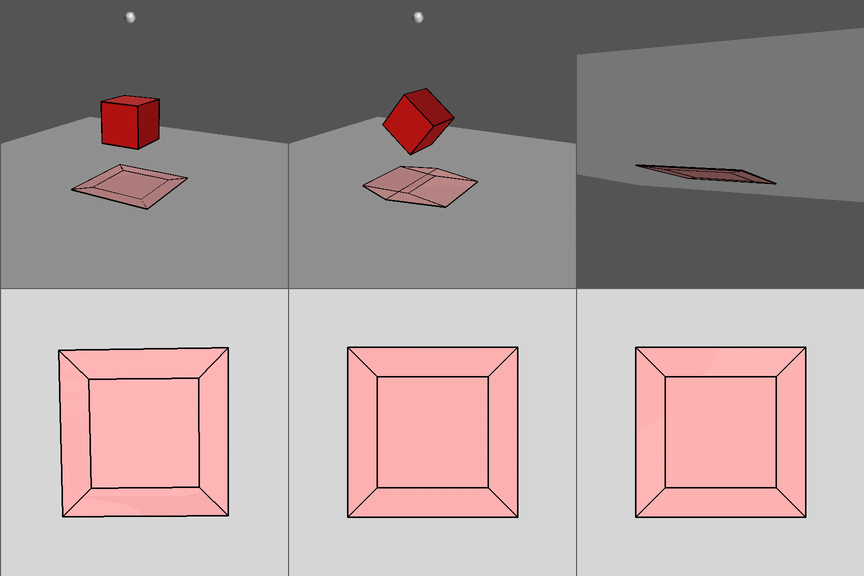
As the Cube Turns
This unit opens with an overhead display, generated by a program on a graphing calculator. The two-dimensional display depicts the rotation of a cube in three-dimensional space. The students' central task in the unit is to learn how to write such a program.
Though the task is defined in terms of writing a program, the real focus of the unit is the mathematics behind the program. The unit takes students into several areas of mathematics. They study the fundamental geometric transformations—translations, rotations, and reflections—in both two and three dimensions, and express them in terms of coordinates. The analysis of rotations builds on the experience they have just had in High Dive with trigonometric functions and polar coordinates, and leads them to see the need for and to develop formulas for the sine and cosine of the sum of two angles. Working with these transformations also provides a new setting in which students can work with matrices, which they previously studied in connection with systems of linear equations.
Another complex component of their work is analyzing the way to represent a three-dimensional object on a two-dimensional screen. They have an opportunity to see how projection onto a plane is affected by both the choice of the plane and the choice of a viewpoint or center of projection.
The unit closes with two major projects, which students work on in pairs: They write a program to make the cube turn, and they program an animated graphic display of their own design.
Sunday, November 18, 2007
HW 24: Up, Down, Splat!
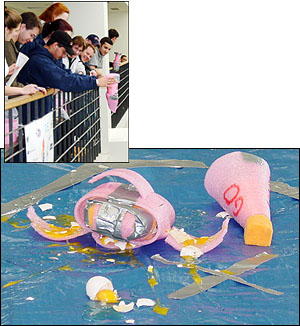
Melissa's science class is having a contest. The contest is to see who can build a container that will keep an egg from breaking when dropped from the school window.
Melissa is quite confident about her contraption. She leans out the window, which is 25 feet off the ground, and hurls her egg container straight up in the air with an initial velocity of 35 feet per second. (Consider velocity upward to be positive.)
Assume that the egg container's velocity is affected by gravity in the usual way. That is, the velocity decreases by 32 feet per second for each second the egg container travels.
1. How long does it take for the egg container to hit the ground?
2. At what speed does the egg container hit the ground?
Thursday, November 15, 2007
Velocity is Speed with Direction
In class we have looked at several scenarios dealing with acceleration and velocity. We have used the following formulas:
h = -10t^2 - 30t + 200 from Look Out Below
h = -16t^2 - 7.85t + 65 from HW22: Big Push
h = -16t^2 + 50t + 90 from HW23: Problem 2c
What is the significance of the sign of the velocity term? - 30? - 7.85? + 50?
Is the sign of the velocity term for our Ferris wheel problem always negative (- 7.85) as seen from HW22?
Subscribe to:
Posts (Atom)